By the time a part reaches tapping, most of its machining value has already been added. A tap that breaks at this point is more than a lost tool: removing the broken piece takes time, the part is often scrapped and the machine stands still. The good news is that most tap breakages come from a handful of basic mistakes, and they can be prevented.
1. Wrong tap drill size
This is the most common mistake. A cutting tap removes chips to form the thread; a forming tap displaces material instead and therefore needs a larger hole. For metric coarse threads with cutting taps, the rule of thumb is:
| Thread | Cutting tap drill | Forming tap drill (approx.) |
|---|---|---|
| M6 × 1 | 5.0 mm | 5.55 mm |
| M8 × 1.25 | 6.8 mm | 7.4 mm |
| M10 × 1.5 | 8.5 mm | 9.3 mm |
| M12 × 1.75 | 10.2 mm | 11.2 mm |
Forming tap sizes vary slightly by material and manufacturer; always check the tap’s technical data. Using a cutting-tap hole size with a forming tap overloads the tap and breaks it.
2. The wrong tap for the hole
- Blind hole: A spiral flute tap lifts chips up and out of the hole.
- Through hole: A spiral point tap pushes chips ahead and out of the bottom, allowing higher speeds.
- Ductile materials: In aluminium and low/medium carbon steel, forming taps produce no chips and give stronger threads.
- Brittle materials: Forming taps are not used in cast iron; choose a straight flute or suitable cutting tap.
3. Chip packing and bottoming out
In blind holes the chips have nowhere to go. Drill the hole deeper than the thread length by the tap’s chamfer length plus a few pitches of safety, and program the tap so it never touches the bottom. A tap hitting the bottom is the most sudden and expensive cause of breakage.
4. Synchronisation and tapping chucks
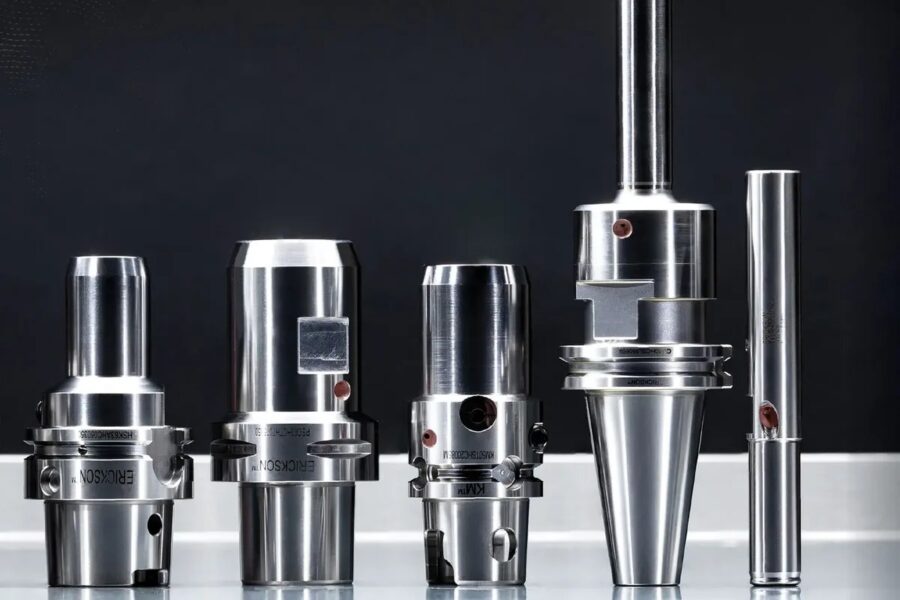
Modern CNC machines support synchronous (rigid) tapping: spindle rotation and Z-axis feed are locked together, so rigid or micro-compensating holders can be used. If the machine does not support it, or is an older model, an axially compensating tapping chuck is essential; otherwise small differences between feed and pitch strain the tap.
Even in synchronous tapping the feed must equal the pitch: for M10 × 1.5 the feed is 1.5 mm per revolution.
5. Misalignment
If the hole and the tap are not on the same axis, one side of the tap takes extra load. This often happens when drilling and tapping are done on different machines or setups. Drill and tap in one setup where possible, and check holder runout.
6. Poor lubrication
Tapping runs at low speed with a large contact area, so lubrication is the coolant’s most important job. Use a well-lubricating cutting fluid at the right concentration, especially in stainless steel and with forming taps. Through-coolant taps also help clear chips from blind holes.
7. Speed and coating that don’t suit the material
Catalogue tapping speeds are given by material group. Running a tap made for steel at the same speed in stainless wears it out fast. Coating matters too: in sticky materials the right coating keeps chips from welding into the flutes.
The alternative: thread milling
On expensive parts, large diameters and difficult materials, thread milling is a strong alternative. The thread mill is smaller than the hole, clears chips easily and, even if it breaks, comes out of the hole without trouble. One tool covers several diameters and the thread tolerance can be adjusted in the program.
Successful tapping depends heavily on the quality of the pre-drilled hole. See our carbide drilling guide for the right hole.