The top of a part is easy to machine on a machining centre, but a hole in its side, a slot or a keyway in a hub often sends the part to another setup or another machine. Each new setup means set-up time, handling, waiting and, above all, the risk of dimensional error. Angle heads and keyway cutting tools let you finish these extra operations on your existing machine in a single setup.
The hidden cost of an extra setup
- Set-up time: Re-clamping, zeroing and checking the part.
- Error stack-up: Each setup adds small position errors, making tolerances between features from different setups harder to hold.
- Queues and waiting: A part sent to another machine waits its turn there.
- Extra fixtures: Different orientations may need separate fixtures.
What is an angle head?
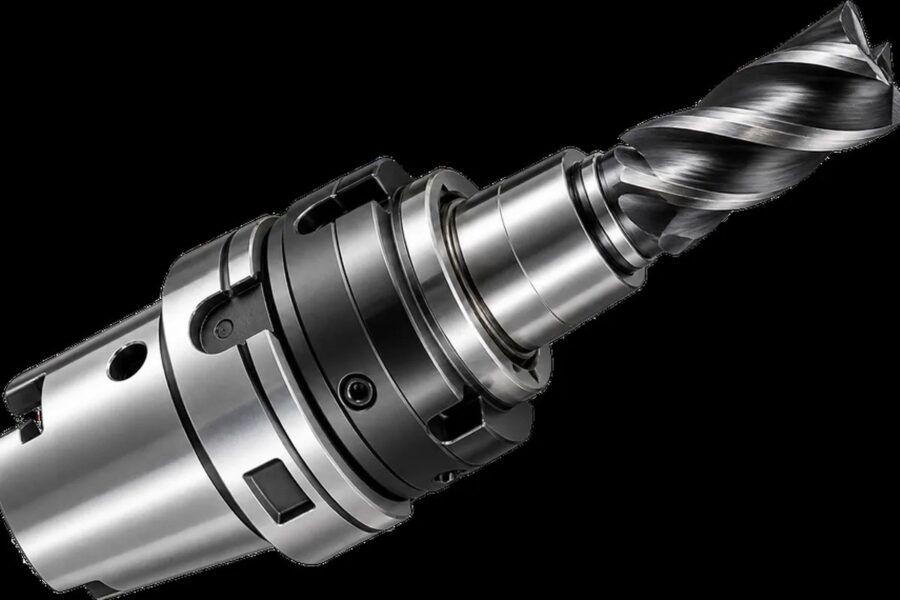
An angle head is a holder that transfers the spindle’s rotation to another axis through a gear train. A vertical machining centre can then drill, mill or tap the side faces of a part.
| Type | Use |
|---|---|
| Fixed 90° angle head | Drilling, milling and tapping side faces |
| Adjustable angle head | Inclined holes and angled faces |
| Double-output / multi-spindle heads | Opposite faces or several holes at once |
| Offset and narrow-access heads | Machining inside deep pockets and tight spaces |
Choosing an angle head
- Interface and stop block: The stop block that keeps the head body from turning must suit your machine’s spindle nose.
- Speed and torque: The head’s maximum speed and transmissible torque must match the job. Heavy milling and small-diameter drilling may need different heads.
- Coolant transfer: Whether the head passes coolant through to the tool matters especially for drilling and tapping.
- Reach dimensions: Body size and the tool output’s distance from the axis decide whether you can work without hitting the part.
- Magazine compatibility: Weight and size must suit the automatic tool changer.
Keyway cutting methods
Keyways in gear, pulley and coupling hubs are traditionally cut on separate machines. A comparison:
| Method | Pro | Con |
|---|---|---|
| Keyseater / slotting machine | Flexible | Slow, separate machine and setup |
| Broaching | Fast in series production | A broach per size, separate machine |
| Wire EDM | Very precise | Slow and costly |
| Keyway tool on the CNC | One setup, no extra machine | Needs suitable tooling and programming |
How is a keyway cut on a CNC machine?
On a CNC lathe or machining centre, keyways are cut by stroking, like a slotting machine: the spindle is locked at a set angle, the tool moves back and forth along Z, and on each return stroke it is fed a little further radially. The cycle repeats until the keyway reaches full depth.
- Keep the radial cut per stroke small, chosen by material and tool width.
- The cutting edge must not rub the surface on the return stroke.
- Direct coolant and air to clear chips from the slot.
- The machine must be able to orient the spindle (C axis or spindle orientation).
When is it worth investing?
Work out how much time and cost the extra operation adds per part, including set-up, handling, waiting and scrap risk. That tells you how quickly an angle head or keyway tool pays for itself. See our cost per part article for the method.